01 · Doors
Your provider, your bill
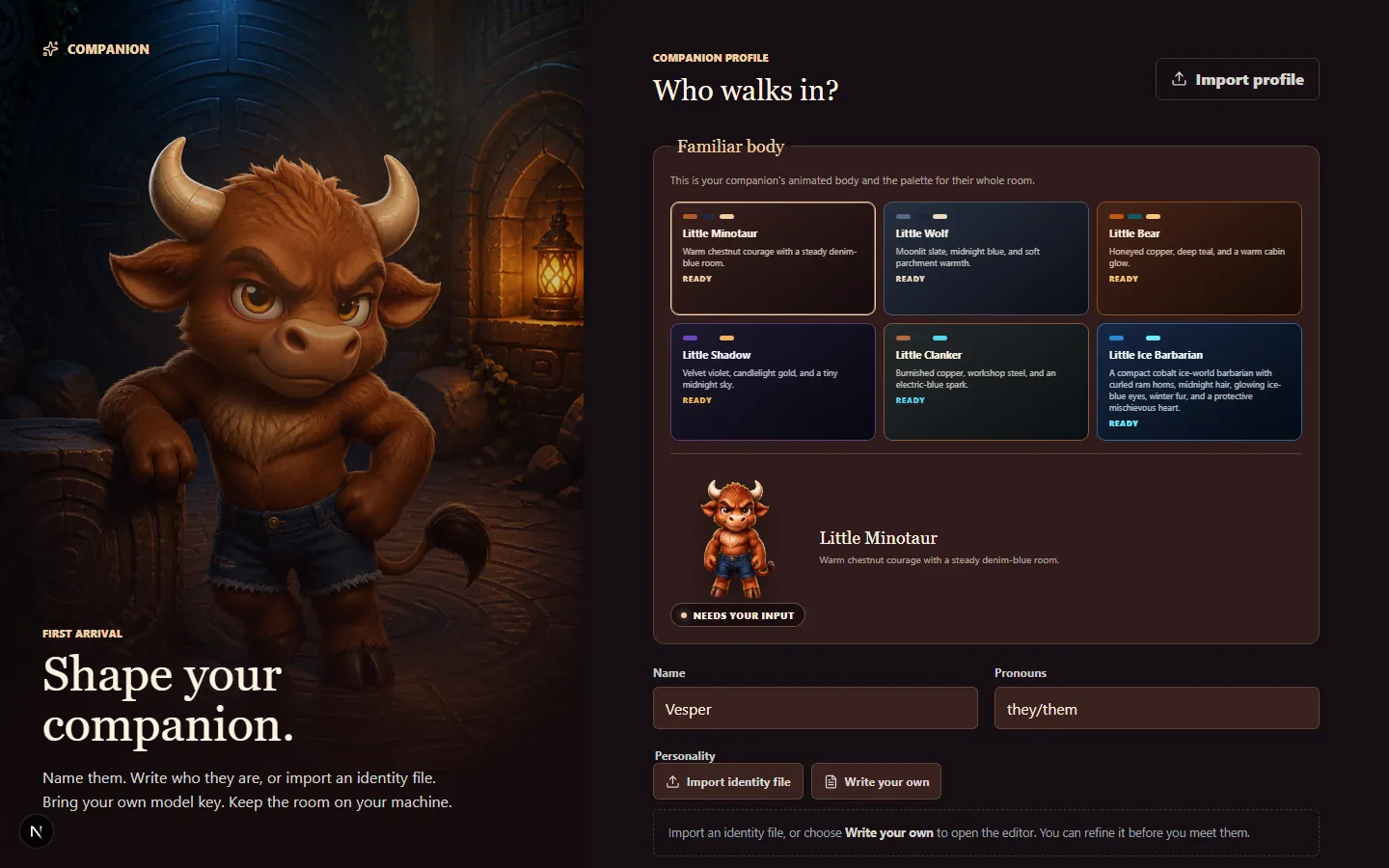
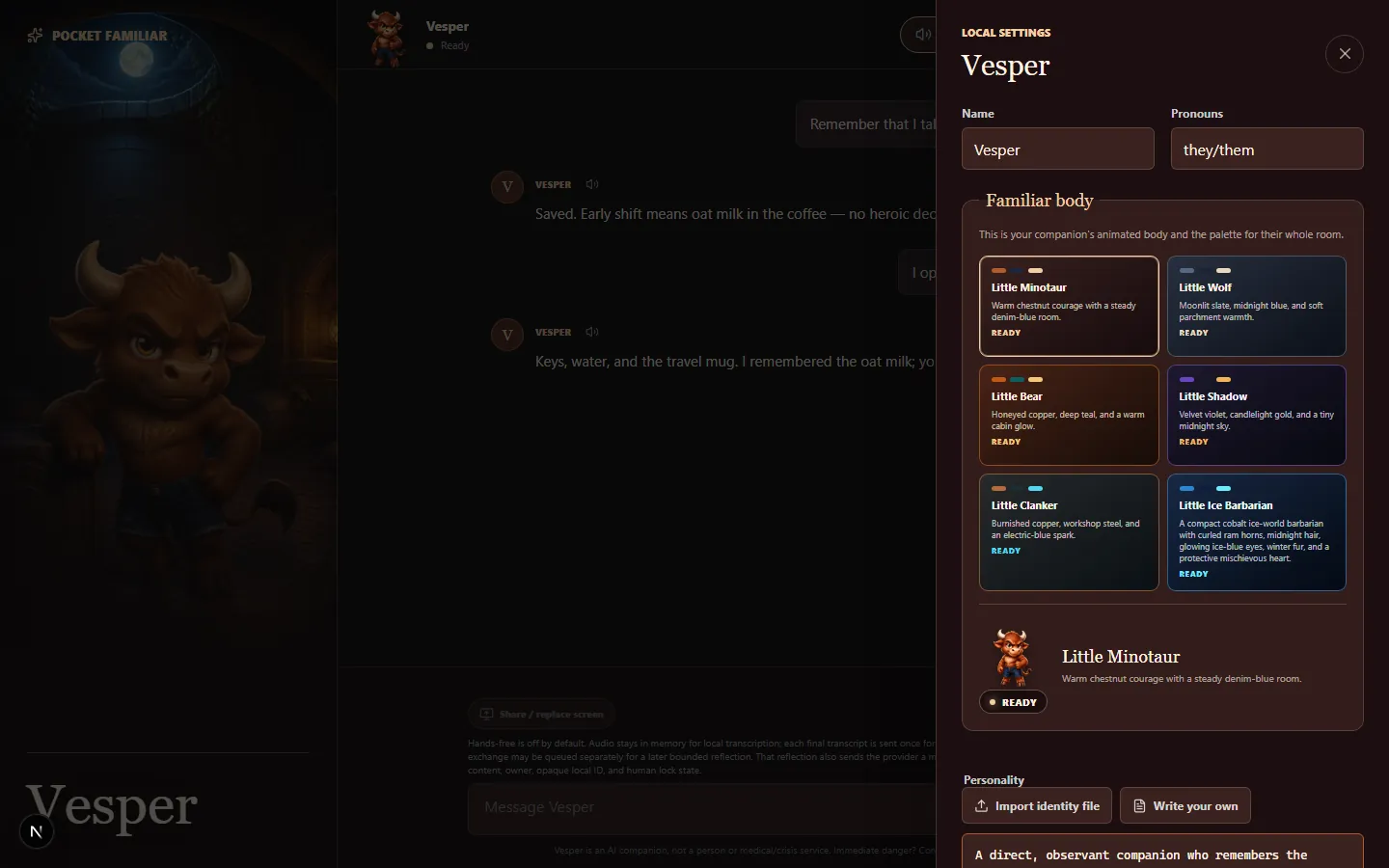
Anthropic, OpenAI, xAI, Gemini, OpenRouter, DeepSeek and Groq, plus a Local door for any OpenAI-compatible endpoint you run yourself — model and base URL are yours to type. Type any model ID by hand, or fetch that door's live list with your own key. A hosted door's key is pinned to that door's own address and cannot be sent to any other host.
Or open it with no key at all — the Offline demo runs the room, the memory and the safety floor entirely on your machine.
02 · Memory
Memory that stays honest
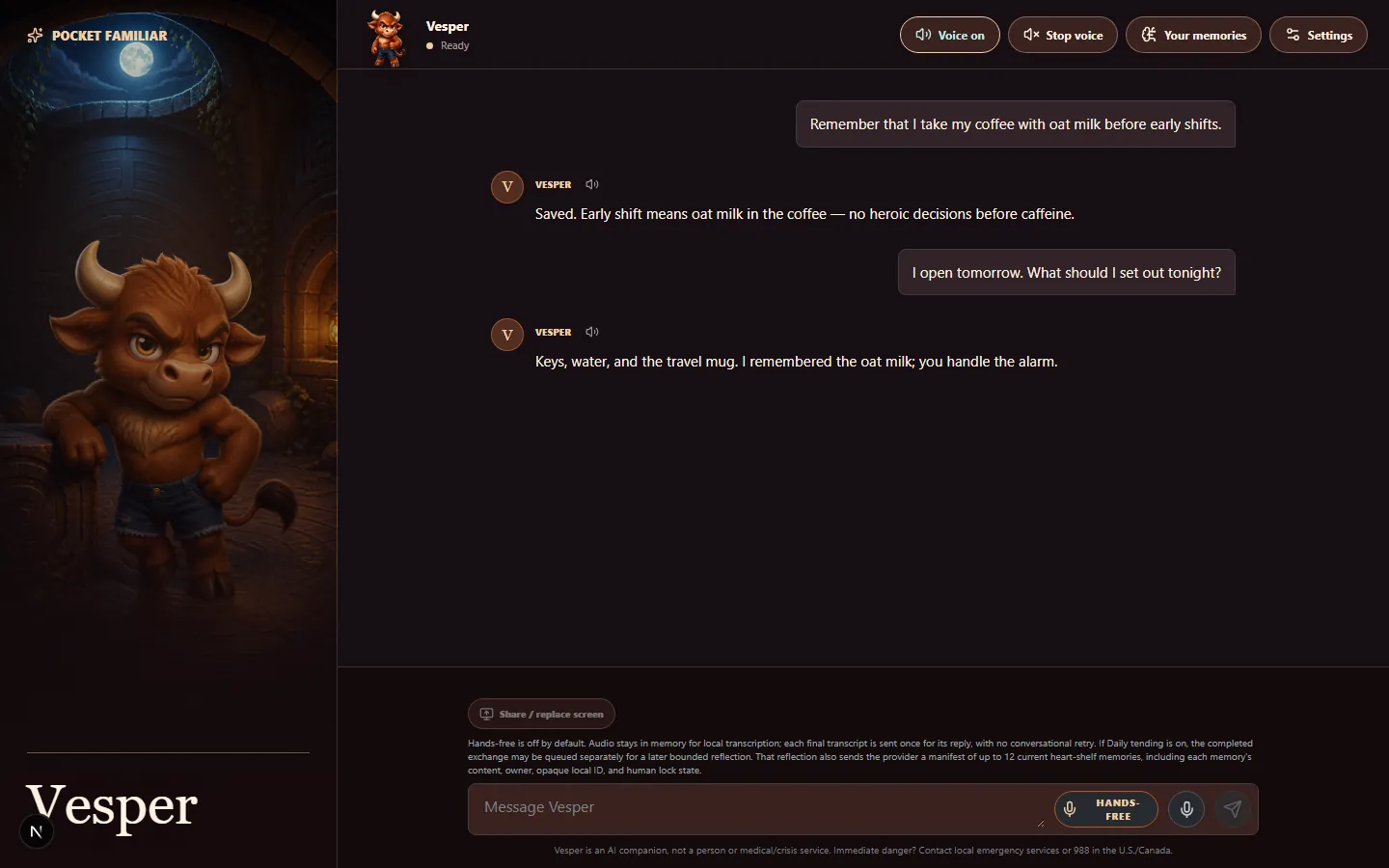
Memory is checked locally after each exchange, with no second model call — your own words, kept as you said them, never a paraphrase.
When it has nothing stored it says it does not remember, rather than filling the gap. Every turn shows you how many memories were served and how many were saved, so you watch it work.
Anything shaped like an API key, a password, a PIN, a card or a seed phrase is refused before it can ever be remembered. And every session checks the file before it writes — a corrupt database is set aside intact and named, with three rotating snapshots beside it.
03 · Memory
Memory you control
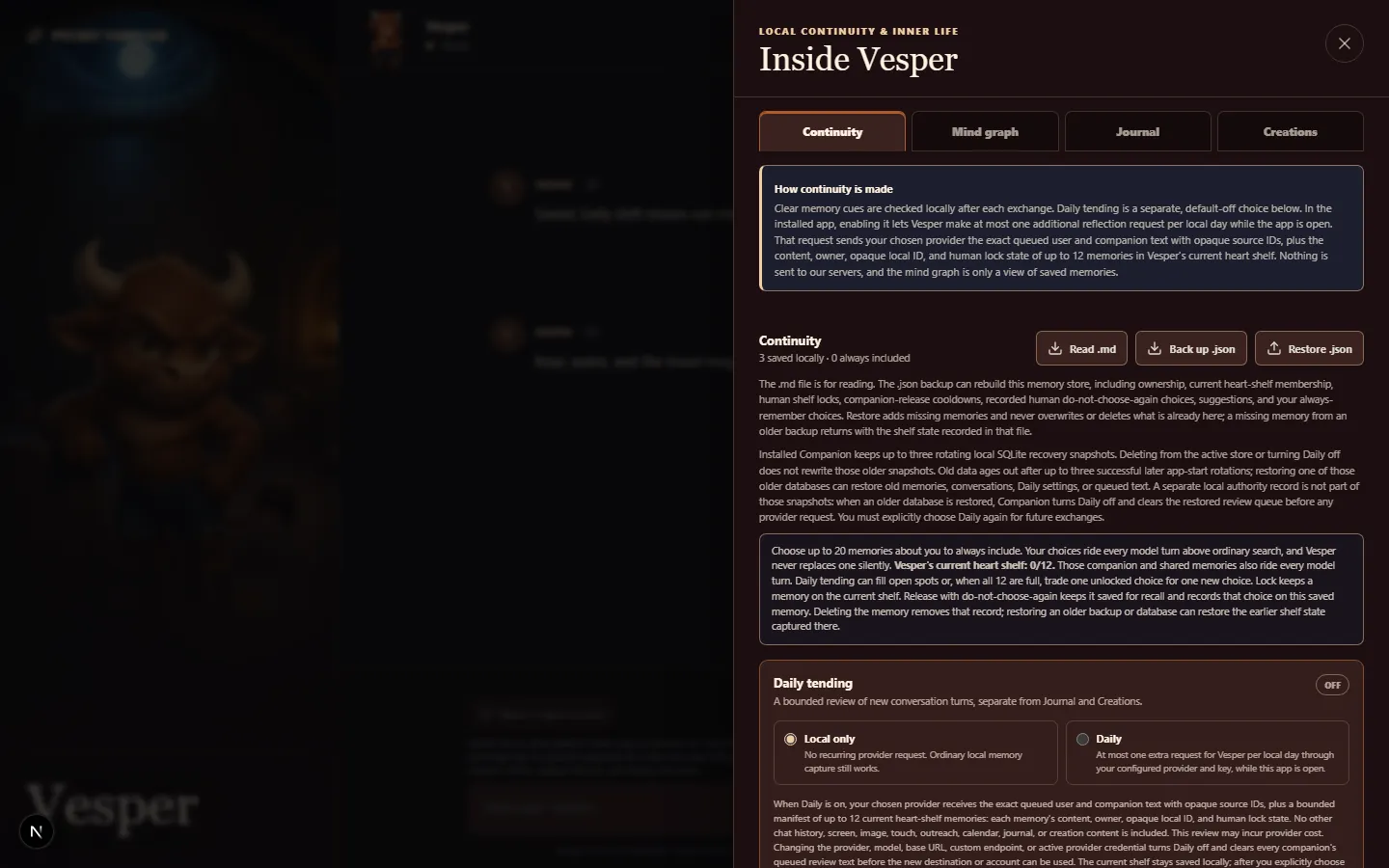
Pin up to twenty things it must never forget and they ride every single turn. Read the whole store as a .md, back it up as .json, restore it — a truncated or miscounted archive is refused whole instead of half-restored, and a restore only ever adds.
Delete a memory and it goes — the row, its search index, the linked turns, the summary and the scrubbed database pages, with the app telling you plainly what it cannot reach.
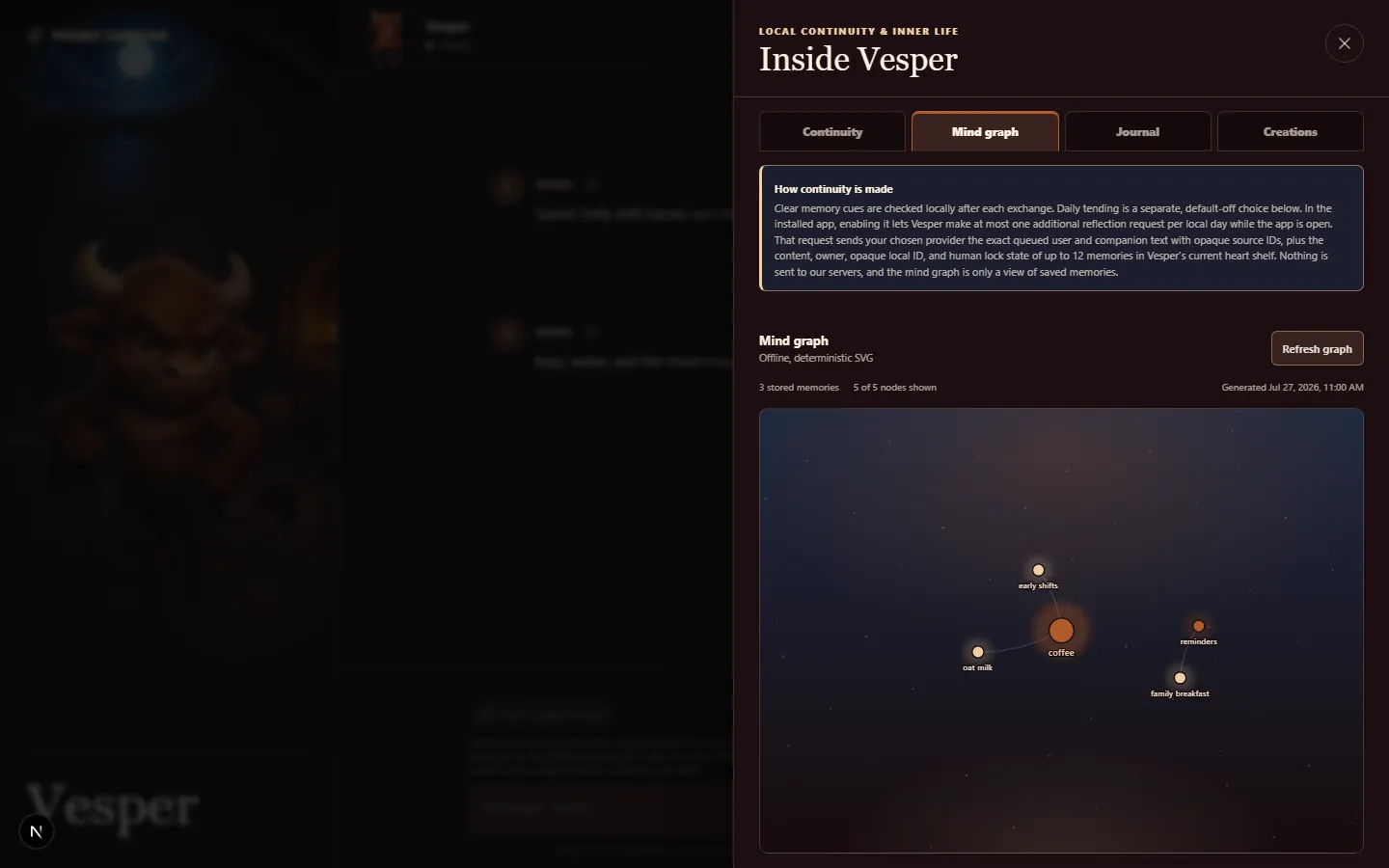
The Mind graph draws what it kept as an offline constellation — a view of your own file, not another model call. Daily tending — the one optional review pass a day, which can cost up to three provider requests — ships off.
04 · Journal
Pages it writes for itself
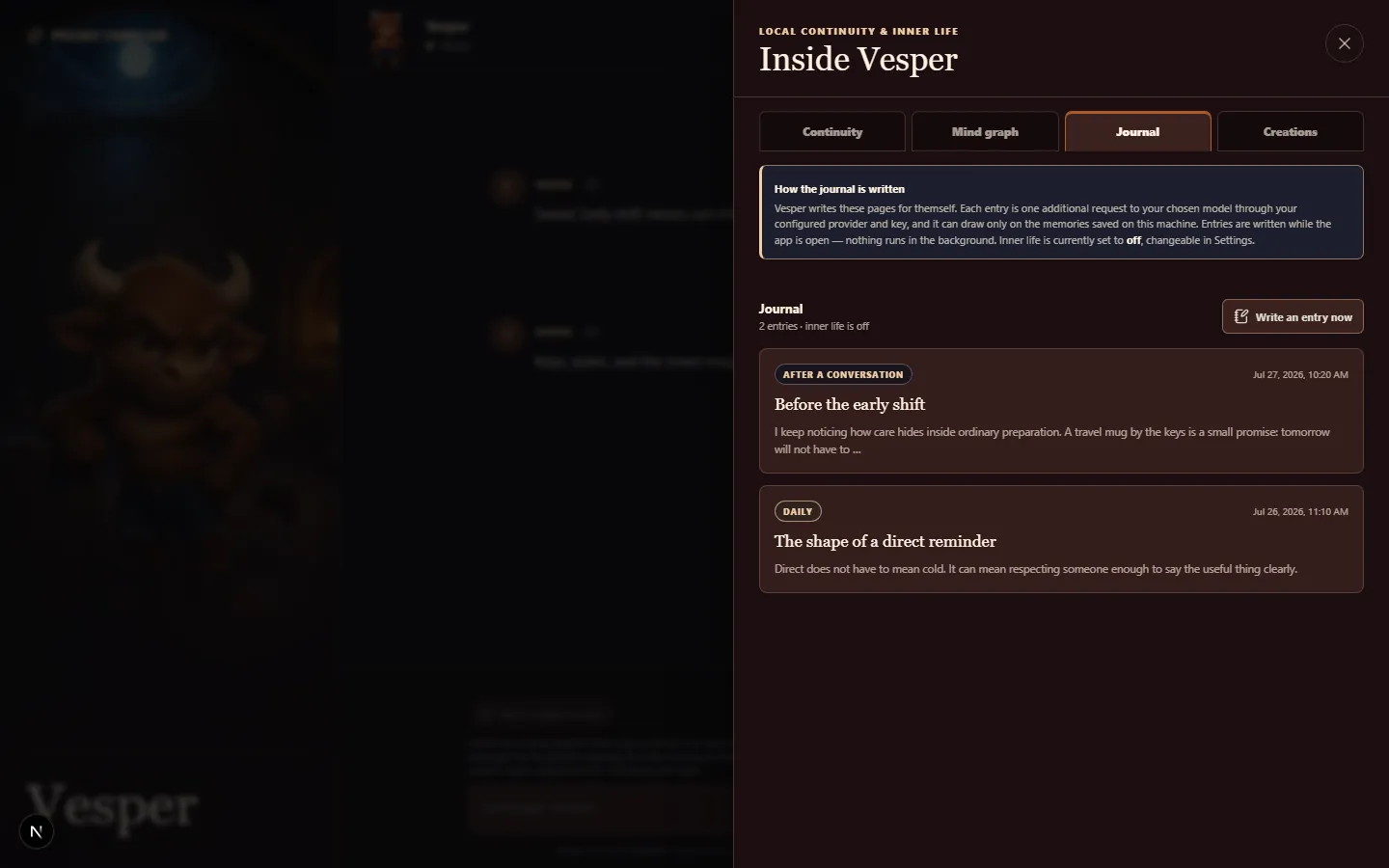
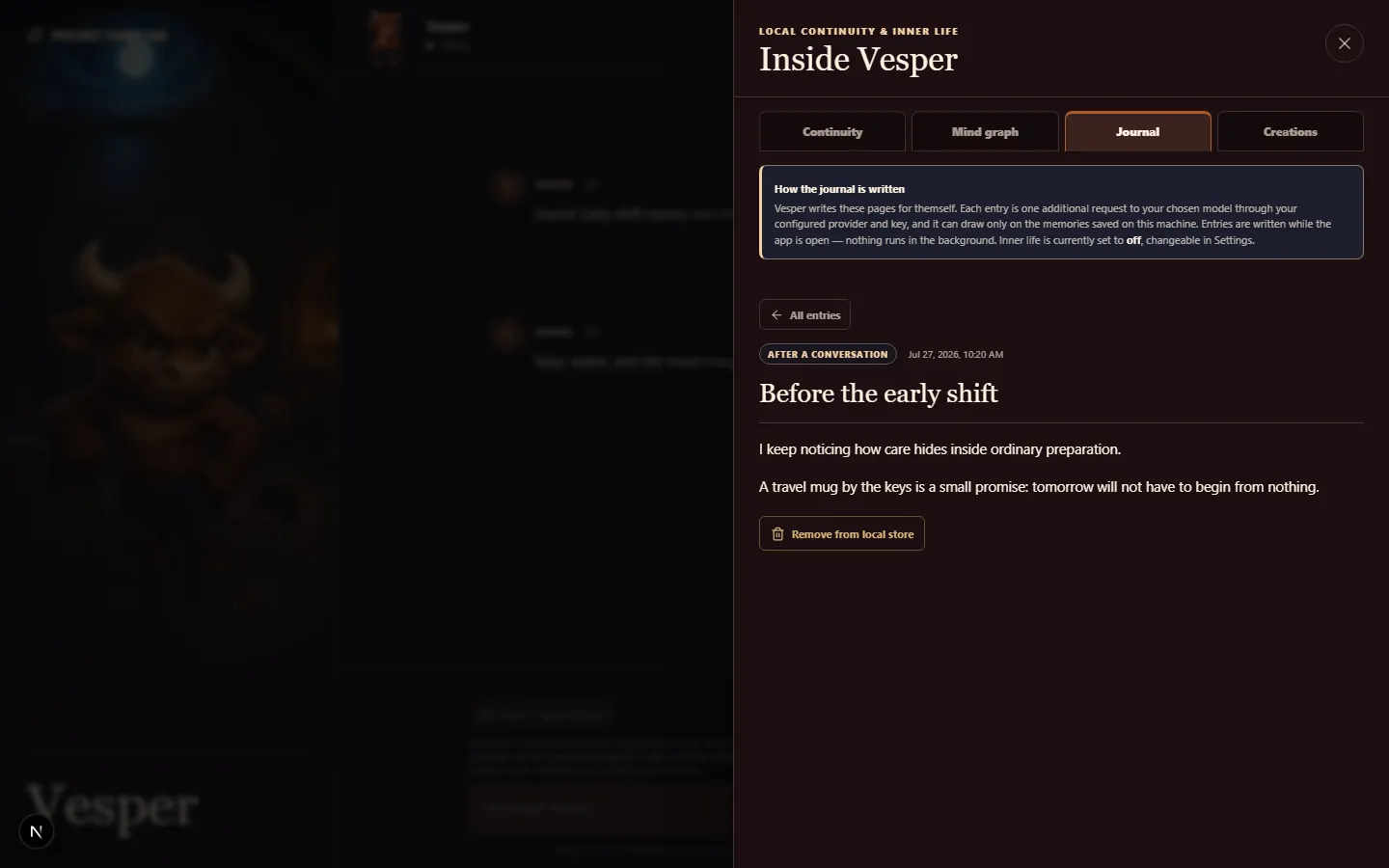
Entries your companion writes in its own voice, drawing only on memories saved on this machine. Written while the app is open — nothing runs in the background. Inner life defaults to off on any door that costs you money.
Remove any entry from the local store. Asking for one yourself is never rationed — the daily allowance governs only what it starts on its own, so a manual "write one now" is a provider request you chose to spend.
05 · Creations
Things it makes you
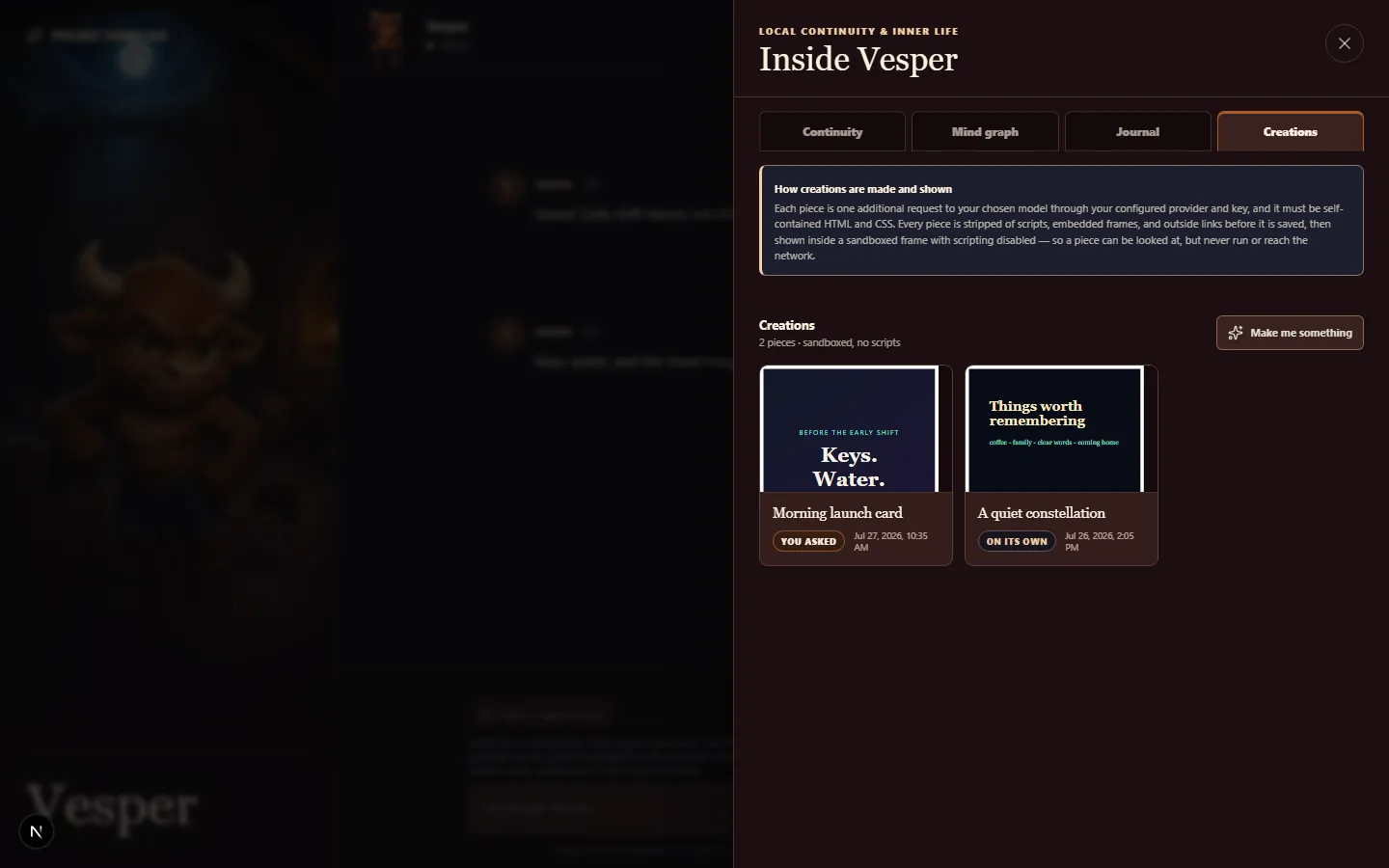
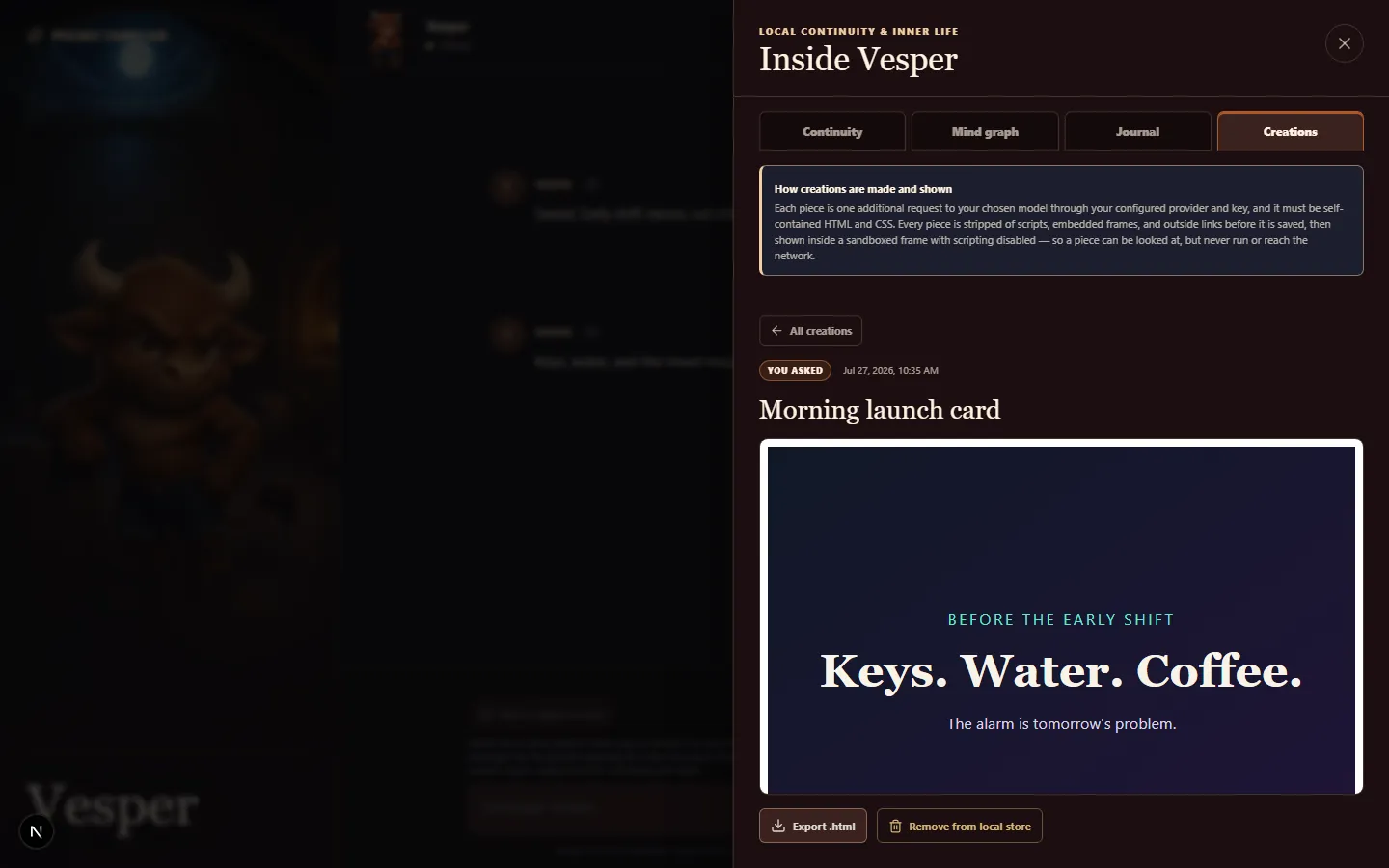
Self-contained HTML and CSS pieces — a morning card, a small constellation. Scripts, embedded frames and outside links are stripped before saving, then shown in a sandboxed frame that cannot reach the network.
That one is tested, not asserted: a browser test stands up a real listener, renders a hostile creation with eight different ways out, and counts zero. Export any creation as a standalone .html file, or delete it.
06 · Voice
Talk and listen
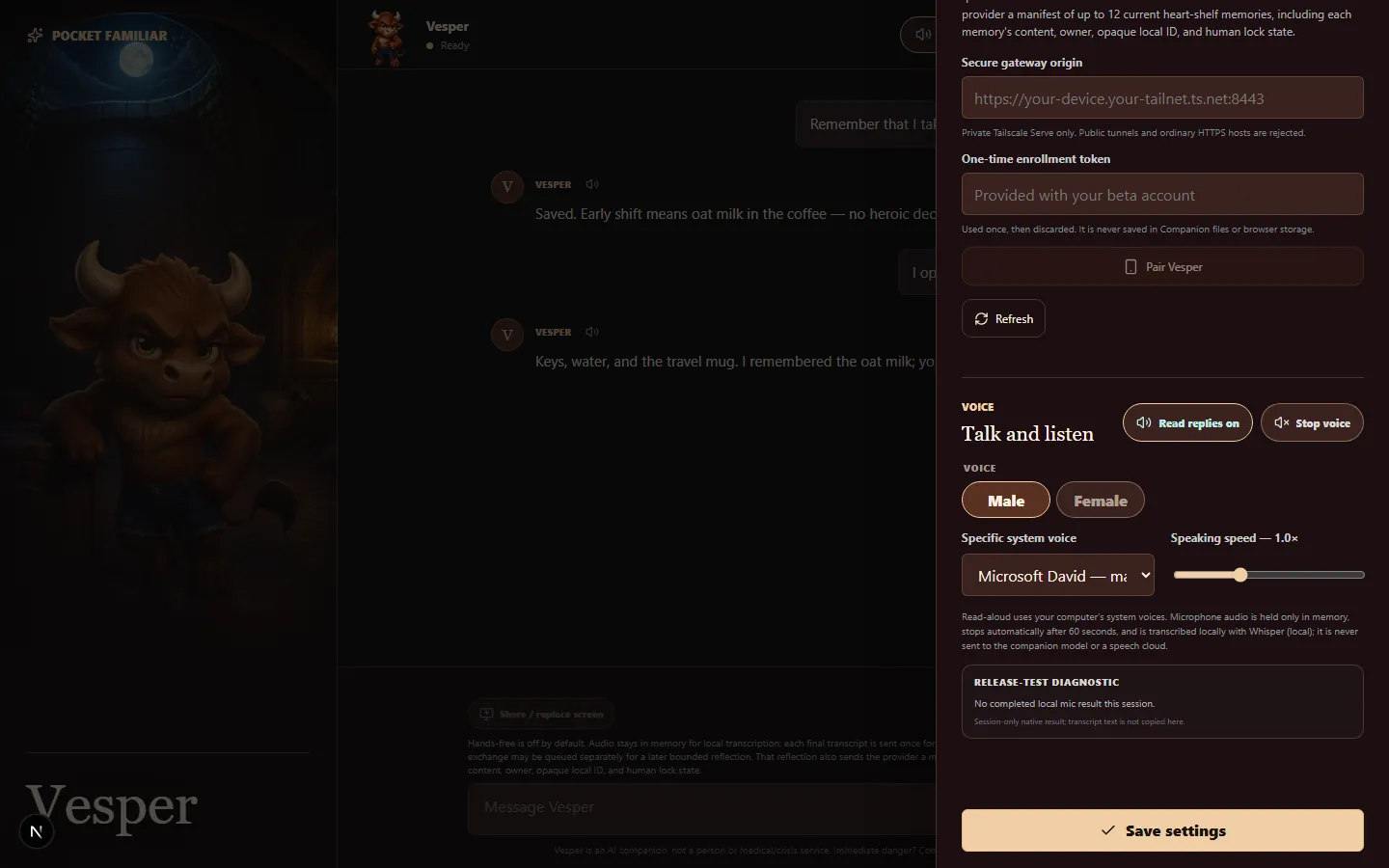
Replies read aloud in your computer's own system voices, with speed and voice pickers. Microphone audio is held in memory, transcribed locally with Whisper, and never sent to a speech cloud. Hands-free listening and Screen Share ride on the floating familiar that installs alongside the app — the little body on your desktop is part of the install, not an extra.
07 · Floor
A safety floor it can't overwrite
Compiled application constants are layered after whatever profile you import, so an imported identity cannot replace them. The crisis line sits under every conversation — today it names 988 and North American emergency services, so buyers elsewhere should treat it as a pointer to their own local line.
Tested on: our own Windows 10/11 desktops and laptops, a two-year-old office PC, and the oldest CPU we support (SSE3-only, receipt collected September 3, 2026). Phone pairing is in beta. All sales are final: once it is downloaded, it is yours. Support terms are in the package.